
When it comes to the most basic form of news delivery, facts keep piling up in a way that makes native apps more and more questionable. Here is why it’s worth considering a move back to mobile sites or web apps…
One of the most shared statistic on mobile use is this one: Applications account for 86{69ae0a25d93a3bfb4c7a14c6cb5bc2b4db8e6111ae4c35307d8a6dded8443ab9} of the time spend b’y users. This leaves a mere 14{69ae0a25d93a3bfb4c7a14c6cb5bc2b4db8e6111ae4c35307d8a6dded8443ab9} for browser-based activities, i.e. sites designed for mobile, either especially coded for nomad consumption, built using responsive design techniques that adapt look and feel to screen size, or special WebApp designs such as FT.com.
This 86/14 split is completely misleading for two reasons: the weight of mobile gaming, and the importance of Facebook.
Take a look at this chart form Flurry Analytics:
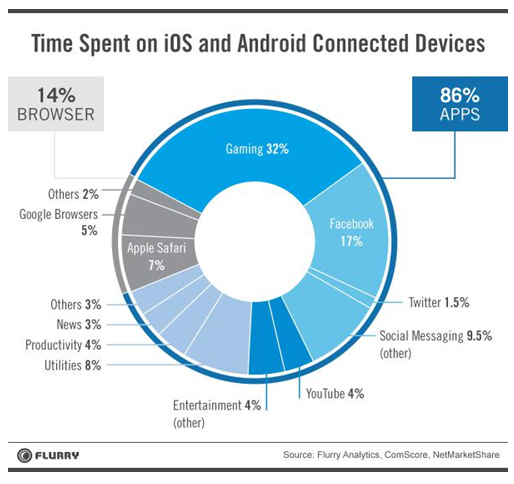
If you combine gaming, Facebook and Social Messaging, roughly 60{69ae0a25d93a3bfb4c7a14c6cb5bc2b4db8e6111ae4c35307d8a6dded8443ab9} of time spent on mobile is swallowed by this trio. As for Facebook, it reaped the top four slots in downloads for non-gaming apps worldwide:
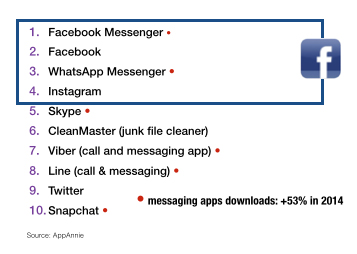
Mobile consumption will concentrate even more as messaging and free direct communication (red dot in the chart) combine into the fastest growing segment by far. Mobile carriers have reason to be scared. Consequently, Facebook will tighten its grip on the mobile ecosystem as it commands the two dominant direct communication apps. If this wasn’t enough, there are two other fast-growing usages: Video streaming (+44{69ae0a25d93a3bfb4c7a14c6cb5bc2b4db8e6111ae4c35307d8a6dded8443ab9} downloads last year) and Travel & Transportation — Uber, AirBnB, CityMapper — (+31{69ae0a25d93a3bfb4c7a14c6cb5bc2b4db8e6111ae4c35307d8a6dded8443ab9}.)
The main characteristic of these services is they couldn’t be designed outside of a full-fledged application: They require key phone features not easily accessible through a browser such as radio modules, GPS, image rendering (for maps, graphics), camera, etc.
By comparison, news-related applications do not requires a lot of phone resources. They collect XML feeds, some low resolution images and render those in pre-defined, non-dynamic templates. They use a tiny fraction of a modern smartphone’s processing power.
In fact, for news media, as the following matrix shows, native apps (iOS, Android and soon Windows) become a questionable proposition:
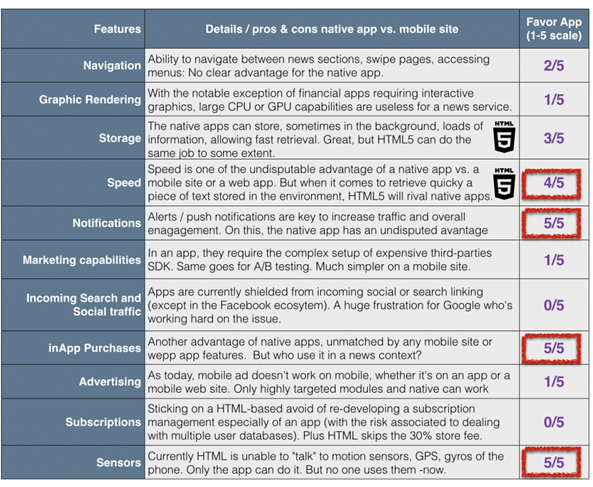
Summing up, apps for news distribution are technically justified for speed, ability to send notifications, inApp purchases, and the hypothetical use of phone sensors. That’s much money and a lot of complications for a small number of features. (On this subject, see the previous The Future of Mobile Apps for News column.)
Unless you are fighting for the prime phone screens, say the first three swipes, or if you are determined to provide key visual or functional differentiators, going for a set of native apps must be carefully weighed. Depending on the level of sophistication and required features, developing a native application costs between $50,000 and $100,000, for each environment, plus dedicated SDKs for marketing, analytics, etc., plus a 30{69ae0a25d93a3bfb4c7a14c6cb5bc2b4db8e6111ae4c35307d8a6dded8443ab9} fee paid to the app store if you go for a paid or subscription model, plus hassles for approval of the smallest update in the messy iOS App Store…
But if you are already big on social and SEO, a mobile site, lightweight, clearly focused on a small feature set can be quite effective. Disappointing as it may be, HTML5-based web apps are all but dead (the difficulty lies in finding good developers and in managing them.)
Among all players, Google has the ability to overhaul the mobile ecosystem. If it comes up with an SDK or a framework aimed at creating simple and effective apps, indeed with limited performance but with enough features to accommodate news delivery, this could become an industry game-changer.
Read the original post at Mondaynote.com